There’s a particular moment every home Pilates practitioner remembers – the first time a session at home actually felt like a studio class. The resistance responded the way it should. The alignment cues made sense because the apparatus was built to support them. The workout stopped feeling like an approximation and started feeling like the real thing.
That shift almost never comes from a new app, a new instructor, or more discipline. It comes from equipment.
Many people spend months bouncing between YouTube videos and a thin mat, wondering why their home practice plateaus while their friend’s studio sessions keep delivering results. The honest answer is that Pilates, more than most fitness disciplines, is an equipment-dependent method. Joseph Pilates didn’t design a stretching routine—he designed a system of apparatus, each piece engineered to load the body in a specific way. Recreate that apparatus accurately at home, even in miniature, and you recreate the results. Skip it, and you’re doing a different exercise altogether, however similar it looks.
So the real question isn’t whether you can get studio-style classes at home. It’s about which equipment actually delivers that experience—and which purchases quietly fall short of it. Here’s a grounded, practical breakdown.
Why “Studio-Style” Depends Entirely on the Apparatus
Before getting into specific machines, it’s worth understanding what actually makes a class feel like a studio class in the first place.
It isn’t the instructor’s voice, the music, or the room. It’s the quality of resistance feedback the equipment provides your body. On a well-built reformer, the carriage glides evenly, the springs load predictably, and every subtle shift in your alignment is reflected back to you instantly. That feedback loop teaches your body correct movement patterns over time. On cheap or poorly manufactured equipment, that feedback is inconsistent – springs wear unevenly, carriages stick or rattle, and frames flex under load. Your body compensates for the equipment’s flaws instead of correcting its form, and the exercise stops doing what it’s supposed to do.
This is why the equipment conversation matters more in Pilates than in almost any other home workout category. A slightly under-built yoga mat barely changes your practice. A slightly under-built reformer changes almost everything about it.
With that in mind, here’s what actually earns a place in a home studio setup—starting with the piece most people think of first.
1. The Reformer — The Foundation of Any Home Studio
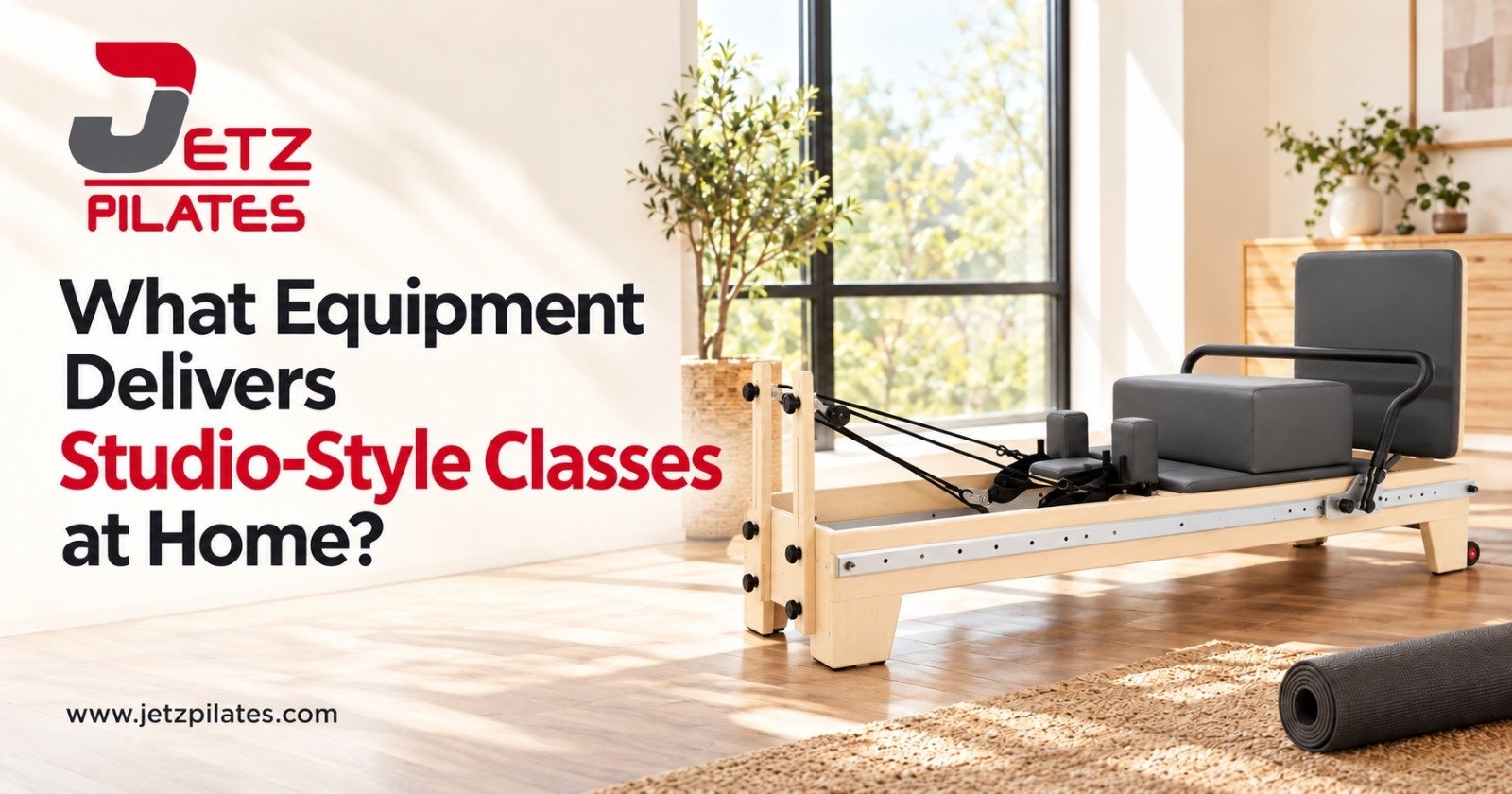
If you can own only one piece of equipment, it should be the reformer. It’s the closest thing Pilates has to a “main machine,” and it’s capable of delivering full-body strength work, mobility training, and rehabilitation-style movement in a single session.
A reformer consists of a sliding carriage, a set of springs providing adjustable resistance, a footbar, and long straps with handles. The distinction between a genuine studio-grade reformer and a budget imitation lies in a few specific factors:
- Spring consistency — matched, calibrated springs that maintain even resistance across the full range of motion, rather than springs that lose tension unpredictably.
- Carriage glide — smooth-rolling bearings on a solid track, so the carriage moves without sticking, jerking, or excess noise.
- Frame rigidity—a frame (wood or metal) that doesn’t flex or wobble under load, especially important for taller or heavier users or for dynamic exercises that shift body weight quickly.
- Footbar and strap adjustability—precise adjustment points so the machine fits different heights and exercises accurately.
For anyone serious about building a home practice that mirrors a studio session, prioritizing the budget for a reformer is essential. A well-built reformer – whether a classic wooden design or a modern extra-long-footbar version – will outlast a decade of daily use, whereas a poorly built one often needs replacing within a year or two of the tension loosening and the carriage wearing down.
If you’re also considering group or semi-private sessions at home, look at reformer-and-tower bundles, which add a vertical frame with push-through bars and long springs – instantly unlocking the standing, kneeling, and rotational exercises that make studio classes feel dynamic rather than repetitive.
2. The Cadillac (Trapeze Table) – For the Full-Range Studio Experience
The Cadillac (also called the trapeze table) is often the piece that separates a serious home studio from a basic setup. It’s a larger, more versatile apparatus, and it’s what most instructors reach for when they want to combine strength, suspension, and mobility work in one flowing sequence.
At home, a Cadillac unlocks:
- Suspended leg and arm work using the trapeze bar
- Deep spinal traction and decompression
- Roll-down bar exercises for core sequencing
- A giant range of assisted stretching options
It takes up more floor space than a reformer, which is why it’s typically the second major purchase rather than the first – but for anyone who wants their home sessions to genuinely mirror a full studio class (rather than just the reformer-focused portion of one), it closes a real gap. Look for a convertible or full-height Cadillac with a solid push-through bar and multiple spring attachment points since this is what allows an instructor—or a well-structured home program—to move fluidly between exercises without stopping to reconfigure the apparatus.
3. The Wunda Chair – Compact, Intense, and Studio-Authentic
Not every home has the floor space for a reformer and a Cadillac. This is where the Wunda Chair (also known as the Pilates Chair or Combo Chair) earns its reputation as the most space-efficient way to get a genuinely studio-grade workout at home.
Don’t let the size fool you. The chair uses a small footprint and a spring-loaded pedal system to deliver some of the most demanding exercises in the entire Pilates repertoire—pistol squats, tricep presses, standing balance work, and seated spinal articulation among them. Because the resistance is concentrated into such a small range of motion, the pedal quality and spring calibration matter enormously; an inconsistent pedal can make an exercise feel either too easy or dangerously unstable.
For apartment-based practitioners, or anyone building a home studio in stages, the Wunda Chair is frequently the second or third purchase after a reformer – compact enough to fit in a corner but capable of producing the kind of controlled, high-intensity work that studio-goers associate with an advanced class.
4. The Ladder Barrel – The Piece Most Home Setups Are Missing
If reformers get the spotlight, the ladder barrel is the piece of equipment most people forget about—and it’s often the one that makes the most significant difference to how “studio-authentic” a home practice feels, particularly for spinal mobility and flexibility work.
The barrel’s curved surface allows for controlled extension and flexion of the spine that’s genuinely difficult to replicate safely on a mat alone. It’s especially valuable for:
- Improving spinal articulation and posture
- Building hip and hamstring flexibility
- Supporting safe extension work for people managing back tightness or early-stage postural issues
- A ladder barrel introduces variety to a routine that would otherwise rely solely on the reformer.
Because it doesn’t require springs or a carriage system, a ladder barrel is also one of the more durable, low-maintenance pieces of equipment you can add to a home studio — a one-time investment that keeps delivering value with essentially no ongoing upkeep beyond basic care of the upholstery and frame.
5. Small Apparatus and Accessories – The Details That Complete a Class
Studio instructors rarely run an entire class on the “big three” apparatus alone. Small equipment ties a session together and adds the layered resistance and stability challenges that make a class feel complete. A well-rounded home setup should include:
- Magic circles (fitness rings) for inner-thigh, arm, and core resistance work
- Resistance bands for portable, low-impact strength additions
- Small stability balls for core activation and balance challenges
- Jump boards (compatible with most reformers) for cardio-style interval work
- Box sets for reformer-based seated and kneeling variations
None of these need to be expensive, but they do need to be well-made—a magic circle that loses its shape or a jump board that doesn’t seat securely on the reformer carriage introduces exactly the kind of inconsistency that undermines the whole point of building a home studio.
Building your setup in the correct order is essential.
Not everyone needs to buy everything at once, and trying to do so is often where home studio plans stall out. A sensible sequence looks like this:
- Start with the reformer — it delivers the widest range of exercises per rupee spent and forms the backbone of nearly every class style.
- Add small apparatus early—rings, bands, and a box are inexpensive and immediately expand what you can do on the reformer alone.
- Bring in a Wunda Chair or ladder barrel next, depending on whether you want compact intensity or spinal mobility work—whichever gap your reformer sessions are missing.
- Consider a Cadillac last, once space and budget allow, to round out the setup into something that genuinely mirrors a full studio membership.
This staged approach means you’re never left with equipment gathering dust—every piece added should immediately unlock new exercises rather than duplicate ones you can already do.
Why Equipment Quality The importance of equipment quality at home surpasses that in a studio. The quality of equipment at home needs to be higher than that in a studio.
There’s one more factor worth being honest about: in a commercial studio, equipment gets inspected, serviced, and replaced on a schedule most home buyers never think about. At home, that maintenance discipline usually doesn’t exist – which means the starting quality of the equipment has to be higher, not lower, to hold up over years of use without a technician checking in every few months.
This is exactly why so many home practitioners end up disappointed with budget equipment. It’s not that cheaper apparatus can’t deliver a workout on day one – it’s that the spring tension drifts, the carriage bearings wear, and the frame loosens faster than expected, and there’s no studio maintenance team catching it early. A few months in, the “studio-style” feeling quietly disappears, and most people don’t even realize the equipment is the reason their sessions feel off.
Investing in genuinely well-built apparatus from the outset – with matched springs, solid frames, smooth glide systems, and manufacturer support behind it – is what actually protects the studio-style experience over the long run, not just on the first day you unbox it.
Bringing the Studio Home
Studio-style Pilates at home isn’t about recreating an entire commercial space. It’s about choosing apparatus that gives your body the same honest, predictable feedback a studio reformer or Cadillac would—starting with a well-built reformer, layering in a Wunda Chair or ladder barrel as your practice deepens, and rounding it out with the small apparatus that adds texture to every session.
Get the equipment right, and the rest – the discipline, the results, the feeling Joseph Pilates promised after those first ten, twenty, and thirty sessions – tends to follow on its own.
If you’re planning a home studio setup and want equipment that’s built to studio standards rather than home-gym shortcuts, JetzPilates offers reformers, Cadillac tables, Wunda chairs, ladder barrels, and studio accessories designed for exactly this kind of long-term, serious home practice—along with guidance on choosing the right combination for your space and budget.
Frequently Asked Questions
Is one reformer enough for a studio-style workout at home?
For most people, yes – at least to start. A well-built reformer alone covers a large percentage of the classical Pilates repertoire, especially once you add small apparatus like a magic circle, box, or resistance band. The Wunda Chair, ladder barrel, and Cadillac each add specific capabilities the reformer can’t fully replicate, but they’re expansions rather than prerequisites.
How much space do I actually need?
A reformer typically needs a footprint of around 2.5 to 3 meters in length once you account for the sliding carriage and strap extension. A Wunda Chair takes up a lot less space – often less than a square meter – which is why it’s the go-to choice for smaller apartments. The Cadillac takes up the most space and is usually planned for once the core setup is established.
Can beginners use studio-grade equipment safely at home?
Yes, beginners can safely use studio-grade equipment at home if it has properly calibrated spring resistance and clear adjustability, allowing for gradual progress similar to instructor-led sessions. It’s worth pairing early sessions with some professional instruction, in person or online, to build correct form before increasing resistance or complexity.
How do I know if a reformer or apparatus is genuinely studio-grade?
Look past the price tag and check the specifics: matched spring sets, smooth carriage bearings, a rigid frame under load, and precise footbar and strap adjustment. A supplier that can answer detailed questions about spring resistance systems, frame construction, and after-sales support is generally a positive sign that the equipment is built for serious, repeated use rather than occasional light exercise.
Does home equipment need regular maintenance?
Yes. Springs, upholstery, and carriage bearings all experience wear over time, especially with daily use. Periodic checks – tightening bolts, inspecting spring tension, and cleaning the carriage track – go a long way toward preserving that studio-quality feel for years rather than months.
Conclusion
Creating a true studio-style Pilates experience at home isn’t about chasing the latest fitness trend or accumulating gadgets—it’s about making thoughtful investments in the right apparatus, each designed to deliver the kind of feedback and versatility that define professional studio sessions. From the reformer, which forms the backbone of any serious setup, to the Cadillac, Wunda Chair, ladder barrel, and carefully chosen accessories, the quality and design of your equipment directly shape your progress and enjoyment.
By understanding the distinct role each piece plays and building your home studio step by step, you ensure every addition brings new depth and authenticity to your practice. Prioritizing well-built, studio-grade equipment not only safeguards your workouts against the frustrations of wear and inconsistency but also keeps your sessions engaging, effective, and genuinely transformative over time.
Ultimately, bringing the studio home is less about replicating a space and more about recreating the unique power and precision of Pilates apparatus. When you choose tools that honor Joseph Pilates’ original vision and support your evolving needs, you set yourself up for long-term growth, resilience, and satisfaction—proving that with the right foundation, the best parts of the studio truly can be yours, right where you are.