Consider this. Your reformers are in, chairs are set up, and a stiff-backed client wants to know what you have for spinal extension. You point to the mat. They remain unconvinced. That’s when a Pilates ladder barrel really comes into its own.
It’s not hard to buy one, but easy to get it wrong. The rungs wobble, the padding sinks, and the wrong size leaves half your clients precariously perched. This guide will assist you in knowing what to look for so that the Pilates ladder barrel you choose will still feel solid five years from now. We wrote it for studio owners, physiotherapists, and instructors who would rather decide once than replace twice.
What Is a Pilates Ladder Barrel?
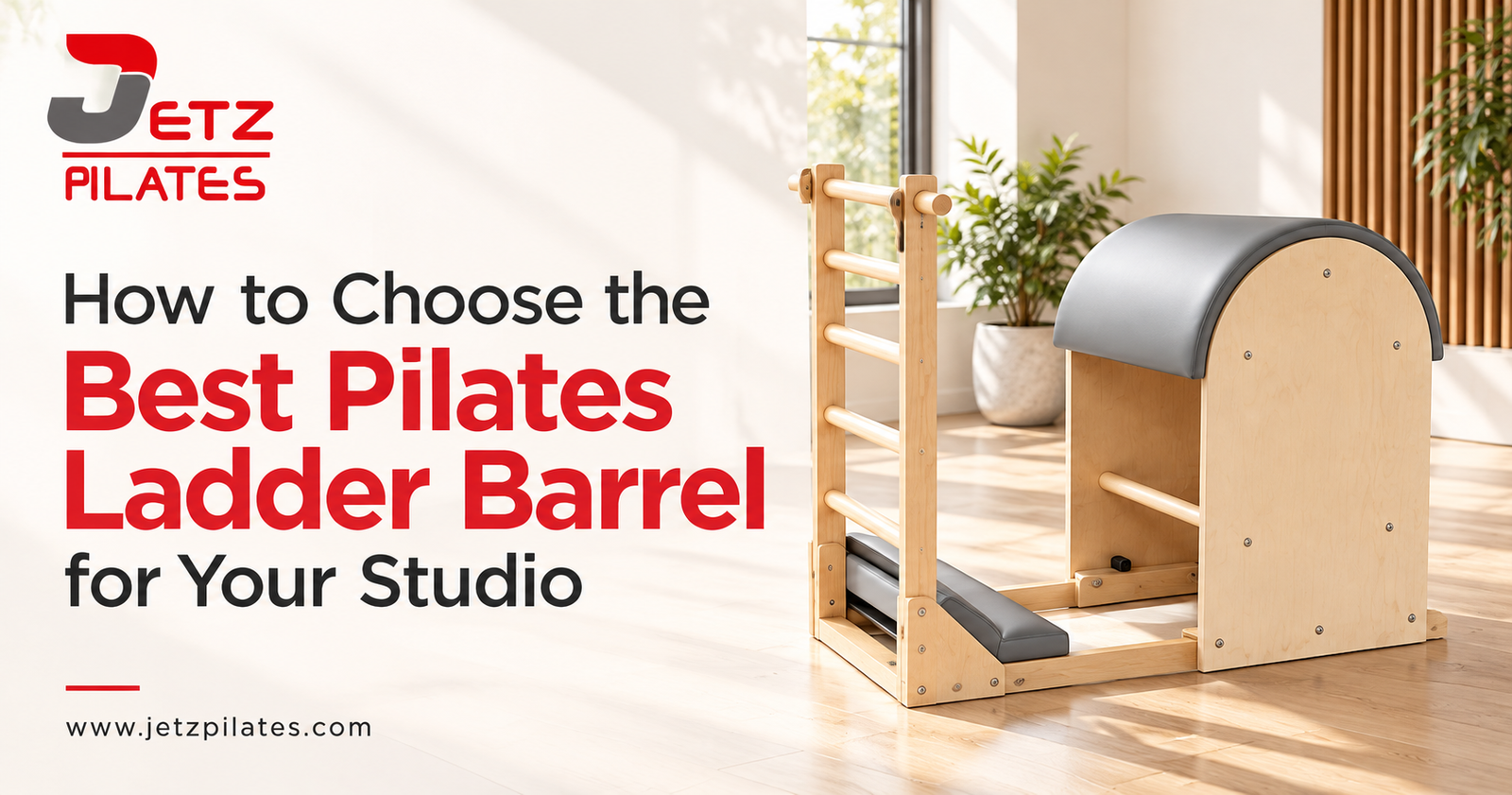
A Pilates ladder barrel pairs a padded, curved barrel with an upright ladder of rungs, joined by a shared base. Joseph Pilates designed it, and it is still one of the most useful tools for stretching, spinal articulation, and side bending. The client lies, sits, or kneels over the curve while hands or feet anchor on the rungs. The shape opens the chest, lengthens the hip flexors, and supports the back through movements that are difficult to manage on a flat mat.
Most models let you change the distance between the ladder and the barrel. That one feature decides how well the equipment fits different leg lengths, so we will come back to it.
Why Studios Add a Pilates Ladder Barrel
A ladder barrel is not a substitute for a reformer and should not be one. It fills in gaps. It’s picked up in mobility work, with clients who can’t lie flat, and in rehab-style sessions where support is more important than resistance. Some therapists use it with pregnant clients after the second trimester when lying on the back is uncomfortable. Others use it for supported bridging with clients with osteoporosis, where avoiding a rounded upper spine is the whole idea.
And it makes commercial sense, too. It has a small footprint, it’s ideal for one-to-one sessions you can charge more for, and it gives group class members a reason to book a private one. A studio with a thoughtfully selected Pilates ladder barrel just looks more complete.
Seven Things to Check Before You Buy
1. Frame material and build
The traditional choice is solid hardwood, such as maple or oak — our own classical maple ladder barrel is built along these lines. It’s warm to the touch, absorbs vibration, and is ideal for a boutique space. Steel frames hold up well against humidity and work for clinics wanting a cleaner, modern look. Both are excellent choices. What counts is bracing. Push the ladder down and slide the frame to the side. If a Pilates ladder barrel squeaks or bends in the showroom, it’ll be worse after a year of daily classes.
2. Adjustability
Look for a stepped or sliding system to change the barrel to the ladder gap. A fixed dimension unit can be charming if your clients are similar in size, but in a mixed community it makes compromises necessary. There’s adjustable spacing for a petite client and a six-footer alike to get comfortable. Ask how fast an instructor can change it up between sessions. If it requires tools, it will be adjusted infrequently.
3. Padding and upholstery
Padding should be firm, not plush. Soft foam is inviting but bottoms out under body weight and leaves clients feeling the wood underneath. The medium-density foam with a non-slip, wipe-clean cover is the sweet spot. Make sure the seams are reinforced and the vinyl can handle disinfectant. Any Pilates ladder barrel has the hidden cost of a cover that cracks within 18 months.
4. Size and footprint
Measure twice. Allow about six feet by four feet of clear floor space so that instructors can spot and move freely. Compare the height of the arc and total length to the height range of clients you teach. Most units fit adults 5’2″ to 5’10”, but taller people may need a longer one. If space is limited, check if one person can easily move the Pilates ladder barrel.
5. Stability and weight capacity
Know what the rated capacity is, and be suspicious of the low end of the scale. Studio equipment absorbs dynamic loads because people push, pull, and move. A non-slip base, floor-friendly feet, and a wide stance are much more important than a fancy finish. If you can, sit on it. Lean into the rungs and test it before you pay.
6. Ladder barrel or spine corrector?
They both belong to the barrel family, and they overlap, but they’re not twins. The spine corrector is lower, easy to store, and deals with basic extension. The ladder barrel adds rungs and a taller arc, which opens up deeper back bends, more stretching variety, and progressions a spine corrector cannot. Many instructors will start with the spine corrector if you can only afford one. Whether you do private, rehab, or classical work, the Pilates ladder barrel gives you more to teach.
7. Budget and warranty
In the U.S. market, professional units typically range from about $1,500 to $2,200, depending on materials and brand. There are cheaper options, but inspect the welds, rung spacing, and upholstery carefully. A long warranty is an indication of the builder’s confidence in the build. Ask about lead times, too, as custom orders can take weeks, and ask if replacement parts, such as footplates, are sold separately. Consider the cost per year of use, not the sticker price. A mid-price Pilates ladder barrel that lasts a decade beats a bargain you replace in three years.
Match the Barrel to Your Studio Type
| Studio type | What to prioritize |
| Boutique group studio | Durable upholstery, quick adjustability, a finish that matches your reformers |
| Private-session studio | Fine adjustability, comfort and a taller arc for progressions |
| Physio or rehab clinic | Stability, easy-clean covers and a clear weight rating |
| Small home studio | Compact footprint, easy storage and simple assembly |
Common Mistakes Buyers Make
The first is to buy on price alone. The second is not looking at the mix of clients. If your members range from small to tall, a fixed frame will frustrate somebody every single day. Third, failing to do maintenance—wipe the covers after each session and check the bolts every month. The fourth is skipping instructor feedback. Ask your teachers which exercises they are going to run, and then compare each Pilates ladder barrel you have on your shortlist against this list.
Finally, don’t treat delivery as an afterthought. A heavy wooden unit and a narrow stairwell aren’t a good combination. Make sure to measure doorways in advance of the truck arriving.
Setting Up for Success After Delivery
Purchasing wisely is only part of the challenge. Before the first class, train instructors on the spacing system and how to size clients by leg length vs. guesswork. Place a small card next to the equipment with the standard settings for short, average, and tall clients. That little habit saves minutes each time you use it and keeps your Pilates ladder barrel from going out of adjustment. Book a quick maintenance check every quarter so a loose bolt never turns into a Pilates ladder barrel that clients quietly steer clear of.
Frequently Asked Questions
What is a Pilates ladder barrel used for?
It is used for extension of the spine, stretching, side bending, and gentle strengthening. The curved barrel supports the back, and the ladder provides something to push against with hands and feet, making deep stretches more controlled and easier to teach.
How much space does a Pilates ladder barrel need?
The unit is compact, but you should allow about six feet by four feet of clear floor space around it. This gives instructors room to move, spot, and adjust without having to navigate around other equipment.
Is a Pilates ladder barrel better than a spine corrector?
Neither is best in all cases. A spine corrector is less expensive and lighter, which works for tight budgets. The Pilates ladder barrel has a higher arc, rungs, and a wider range of exercise, making it more robust for private sessions and rehab work.
Can beginners use a Pilates ladder barrel?
Yes, with guidance. Beginners do well on supported stretches and gentle extension, as long as an instructor sets the spacing correctly for their leg length. Start with small ranges and progress as control improves.
How do I maintain a Pilates ladder barrel?
Wipe upholstery down with mild soap and water or a studio-safe cleaner after each session. Check bolts and rung joints monthly. Tighten anything loose. Keep the unit out of damp corners to keep the frame alive.
Conclusion
Choosing the right Pilates ladder barrel comes down to a few honest questions. Is the frame sturdy? Does the spacing work for your clients? Will the padding handle a busy schedule? Does the footprint fit your floor, and does the price make sense over ten years, not ten minutes? Answer those and the shortlist pretty much writes itself.
If you are looking for help matching a Pilates ladder barrel to your studio, browse the range at JetzPilates and speak to our team about your space, clients, and budget. Learn more about who we are on our about us page. A good barrel will do quiet work for years, and the right one will be the piece your clients keep asking about.