If you have been practicing Pilates for a while, you have probably heard about the ladder barrel—one of the most versatile and underappreciated pieces of equipment in the Pilates world. Whether your goal is spinal flexibility, deep core strength, better posture, or rehabilitation, the Pilates ladder barrel delivers results that are hard to match with any other single apparatus.
At Jetz Pilates, we help practitioners across India understand, choose, and use the right Pilates equipment for their needs. This guide covers everything—from what the ladder barrel actually is to the best exercises to try, who it is right for, and what you can expect to pay in India.
What Is a Ladder Barrel?
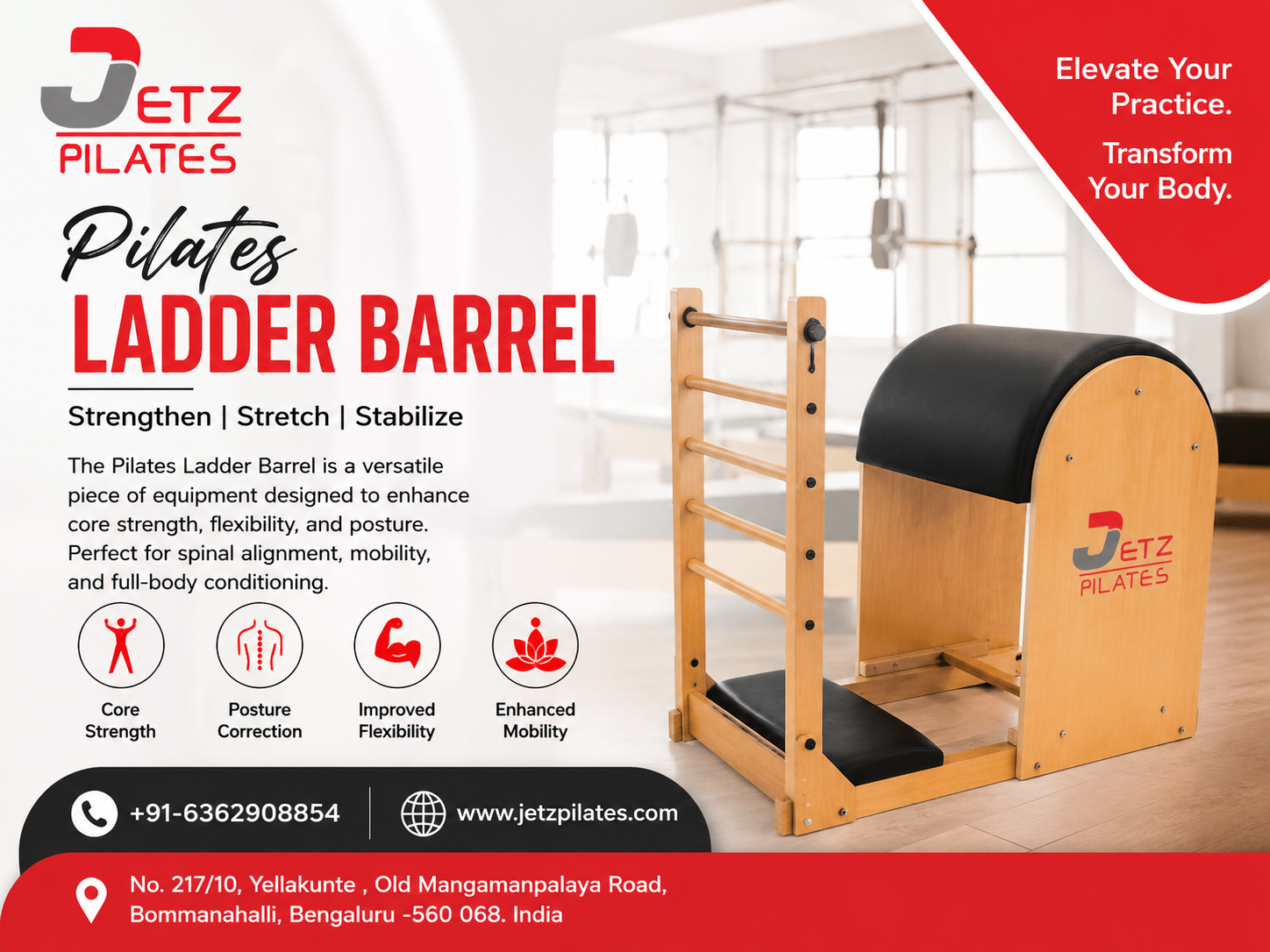
The ladder barrel is one of Joseph Pilates’ original apparatus designs. It consists of two connected components—a wooden ladder with horizontal rungs and a padded, curved barrel—mounted on a sliding base frame. The distance between the ladder and the barrel can be adjusted to suit different body proportions and exercises.
The barrel’s curved surface is the key to its magic. It supports the spine in both extension and flexion, allowing a much deeper and safer stretch than you could achieve on a flat surface. The ladder rungs act as anchor points, giving you something to hold or hook your feet into during exercises, which opens up a wide range of movement possibilities.
Unlike the reformer or the Cadillac, the ladder barrel uses your own body weight rather than springs. This makes it a uniquely honest piece of equipment—there is nowhere to cheat, and every movement demands genuine muscle engagement.
Why Choose Jetzpilates for Your Ladder Barrel Needs?
JetzPilates has been helping Indian Pilates studios, physiotherapy clinics, and home practitioners make smart equipment decisions for years. We understand that buying Pilates barrel equipment in India is a significant investment, and our role is to make that decision easier.
Here is what sets us apart:
- Genuine quality equipment built for Indian climate conditions and everyday use
- Expert guidance on which model suits your body type, goals, and available space
- After-sales support so your equipment stays in top condition for years
- Honest advice—we will tell you when a less expensive option is the right one for you.
We work with both first-time buyers setting up a home studio and experienced instructors equipping commercial spaces.
Spinal Flexibility Benefits of the Pilates Ladder Barrel
The spine is the foundation of every movement in your body. When it is stiff, tight, or misaligned, everything from your posture to your breathing is affected. This is why the ladder barrel is considered one of the most therapeutic tools in classical Pilates.
Spinal Extension
Sitting and slumping over screens for hours every day compresses the front of the spinal discs and shortens the muscles running along the front of the torso. Draping your back over the barrel and opening into extension gradually reverses this pattern. Over time, regular spinal extension work improves breathing capacity and reduces the chronic upper-back tension so many people carry around.
Spinal Flexion
The ladder barrel also supports deep forward flexion in a controlled, supported way. This stretches the erector spinae and the muscles around the lumbar spine — areas that become chronically tight in people who sit for long hours or exercise heavily without adequate recovery.
Lateral Flexibility
Side stretches over the barrel open the intercostal muscles between the ribs, the obliques, and the quadratus lumborum—a deep muscle along the side of the lower back. For people with scoliosis or habitual side dominance, this work is particularly valuable.
Postural Correction
When the spine can move freely in all directions, the body naturally finds better alignment. Regular ladder barrel workout sessions train the postural muscles—particularly the deep stabilizers—to hold you upright with less effort throughout the day.
12 Ladder Barrel Exercises You Should Know
These exercises represent a solid cross-section of the ladder barrel repertoire, ranging from beginner-friendly stretches to more demanding strengthening movements.
1. Spine Stretch Over the Barrel
Sit at the base of the barrel, hook your feet under the lower rungs, and lean back to drape your spine over the curve. Let gravity open the front of your chest and torso. Hold for several breaths, then use your abdominals to curl back up. This is one of the most immediately satisfying ladder barrel exercises for anyone with desk-posture tension.
2. Swan
Lie face down with your hips resting on the top of the barrel and your feet hooked into the lower rungs. Press your hands lightly into the ladder and lift your chest into a back extension. The barrel supports your hips while your back muscles do the work. This is a classic spinal extension exercise and a cornerstone of the ladder barrel workout.
3. Side Sit-Up
Lie sideways over the barrel so the curve runs along your side, with your feet anchored in the rungs. Lower sideways and then lift up using your obliques. This is one of the most effective lateral abdominal exercises in all of Pilates — it requires both control and genuine strength.
4. Mermaid Stretch
Sit on the barrel with one hip and reach over to the opposite side for a long, luxurious side stretch. The barrel elevates your hip, giving the lateral muscles more room to lengthen. This works beautifully for people with tight lats or intercostals.
5. Seated Forward Bend
Sit at the top of the barrel, loop your feet into the upper rungs, and hinge forward at the hips. The elevated position allows you to access a deeper hamstring and lower-back stretch than a standard floor stretch, without rounding the lumbar spine.
6. Hanging
Hold the upper rungs of the ladder, walk your feet back to the barrel, and let your spine decompress as you hang from the ladder. This gentle traction exercise is especially popular with people experiencing mild lower-back compression or tightness.
7. Abdominal Curl Over the Barrel
Lie back over the barrel in flexion with your arms overhead holding a rung and your legs hooked into the lower rungs. Curl your torso up using your abdominals. The curved support of the barrel gives your spine a protected range of motion while your abdominals get a thorough workout.
8. Hip Flexor Stretch
Kneel with one knee on the barrel’s lower surface and let the other foot step forward. The curve of the barrel tilts the pelvis into a position that creates a deep stretch through the front of the hip. For anyone who runs, cycles, or sits for long periods, this exercise is transformative.
9. Back Extension with Rotation
From the swan position, add a gentle rotation of the upper back to one side. This targets the rotator muscles of the thoracic spine—an area that loses mobility quickly and rarely gets worked in conventional exercise.
10. Kneeling Side Stretch
Kneel beside the barrel, place the side of your body against the curve, and reach the top arm overhead. The barrel provides a gentle assist as you open into the stretch. This is a wonderful warm-up exercise and accessible even for beginners.
11. Leg Circles on the Barrel
Lie back over the barrel in extension with your hips at the crest of the curve. Lift both legs to the ceiling and trace controlled circles, keeping the pelvis stable. This challenges the deep hip stabilizers and lower abdominals simultaneously.
12. Push-Up Position with Feet on the Ladder
Place your feet on the lower rungs and hold a plank position. The elevated feet increase the demand on the core and shoulders. Performing a push-up from this position is significantly harder than a standard push-up and a great challenge for advanced practitioners.
Who Should Use the Pilates Ladder Barrel?
The Pilates ladder barrel is suitable for a wide range of people, and that is genuinely one of its best qualities.
- Office workers and remote professionals who deal with tight shoulders, stiff spines, and poor posture from hours at a desk will find immediate relief in regular barrel sessions.
- Rehabilitation clients recovering from back injuries, herniated discs, or post-surgical procedures often use the barrel as a supported, gentle way to rebuild spinal mobility.
- Athletes and active individuals — particularly dancers, swimmers, gymnasts, and runners — use the ladder barrel to improve flexibility and address muscular imbalances.
- Pilates beginners who want a gentler introduction to spinal work before progressing to more complex equipment.
- Advanced Pilates practitioners who want a genuine challenge—many of the upper-level exercises on the ladder barrel are demanding enough to test even experienced movers.
- Seniors looking for safe, effective ways to maintain spinal health and mobility as they age.
- Those with scoliosis or chronic back pain—under proper instruction, the ladder barrel is often prescribed as part of a therapeutic movement program.
Pilates Ladder Barrel Price in India
The price of a Pilates ladder barrel in India varies based on several factors.
What affects the price:
- Material quality — Solid hardwood frames with commercial-grade upholstery cost more than entry-level versions with MDF or softwood.
- Adjustability — Models with smooth sliding adjustment mechanisms and a wider range of positions command a premium.
- Brand reputation—Internationally recognized brands with proven manufacturing standards are priced accordingly.
- Studio vs. home grade — Commercial-grade equipment designed for daily studio use is more expensive but significantly more durable.
Approximate price range in India:
| Type | Estimated Price Range (INR) |
| Basic home-use ladder barrel | ₹35,000 – ₹60,000 |
| Mid-range studio quality | ₹65,000 – ₹1,20,000 |
| Commercial/professional grade | ₹1,30,000 – ₹2,50,000+ |
These figures are indicative. Import duties, shipping costs, and GST can affect final pricing. At Jetz Pilates, we help you understand the true cost of ownership—including warranty support and maintenance—before you invest.
Studio vs. Home Setup — Which Is Right for You?
Home Setup
A ladder barrel for home use makes sense if you practice Pilates regularly and want the convenience of practicing at your own pace without studio fees. A basic to mid-range model will serve most home users well. You will need a dedicated floor space of roughly 6 feet by 4 feet, good ventilation, and a non-slip surface beneath the equipment.
For home buyers, Jetzpilates recommends prioritizing ease of adjustment and durability of the upholstery over aesthetics.
Studio Setup
For a professional studio, durability, adjustability, and ease of use for multiple clients per day are the top priorities. Commercial-grade construction is worth the additional investment because the equipment will be used extensively and needs to remain stable and safe under varying loads. Studios should also consider the visual appeal of the equipment and whether it matches the overall look and feel of the space.
Jetzpilates works with studio owners to choose equipment that balances performance, longevity, and budget—and we can advise on completing your studio setup with complementary apparatus.
Ladder Barrel vs. Spine Corrector—What Is the Difference?
These two pieces of Pilates barrel equipment are often confused, and it is worth understanding the distinction.
The spine corrector (sometimes called the small barrel or step barrel) is a smaller, lower piece of equipment. It has a gentle curve at the top and a step on one side. It is primarily used for spinal articulation and gentle opening of the thoracic spine. It sits closer to the ground and is more accessible for beginners and rehabilitation work.
The ladder barrel is larger and more versatile. The addition of the ladder gives you anchor points that enable a much broader range of exercises—from hanging decompression to advanced abdominal work. The height of the barrel allows for greater range of movement in extension and flexion.
In short, the spine corrector is excellent for foundational spinal work and gentle stretching. The ladder barrel does everything the spine corrector does—and significantly more. If you are equipping a studio, both are worth having. For a home setup with limited budget, the ladder barrel offers more value across a wider range of exercises.
Conclusion
The Pilates ladder barrel is one of those pieces of equipment that earns its space in any serious Pilates practice. It is not flashy or complicated, but it delivers meaningful, consistent results—better spinal mobility, stronger core muscles, improved posture, and a body that moves with greater ease and less pain.
At Jetz Pilates, we are committed to helping you find the right ladder barrel for your goals, your space, and your budget. Whether you are setting up your first home Pilates corner or outfitting a professional studio, we bring the expertise and honest guidance that makes the decision straightforward.
Get in touch with the JetzPilates team today and take the first step toward a stronger, more flexible spine.
Frequently Asked Questions
1. What is a Pilates ladder barrel used for?
A Pilates ladder barrel is used to improve spinal flexibility, build core strength, correct posture, and support rehabilitation. The ladder provides anchor points for a variety of exercises, while the padded barrel supports the spine in both extension and flexion positions, making it one of the most versatile apparatuses in classical Pilates.
2. Is the ladder barrel suitable for beginners?
Yes. Many ladder barrel exercises are gentle enough for complete beginners, particularly the basic spinal stretch, mermaid stretch, and hip flexor stretch. Beginners should ideally start with guidance from a certified Pilates instructor to learn proper positioning before practicing independently.
3. What is the difference between a ladder barrel and a spine corrector?
The ladder barrel is larger, features a wooden ladder with rungs, and allows for a much wider range of exercises, including advanced abdominal work and hanging. The spine corrector is smaller, lower, and primarily designed for gentle spinal articulation and thoracic opening. Both are valuable, but the ladder barrel offers more versatility overall.
4. Can the ladder barrel help with back pain?
Yes, when used correctly under proper instruction. The ladder barrel supports safe spinal extension and flexion, decompresses the vertebrae through hanging exercises, and strengthens the deep stabilizing muscles of the spine. Many physiotherapists and Pilates rehabilitation specialists use it as part of back pain recovery programs.
5. What is the price of a Pilates ladder barrel in India?
Prices in India range from approximately ₹35,000 for basic home-use models to ₹250,000 or more for commercial-grade professional equipment. The final price depends on material quality, brand, adjustability, and import/GST costs. Jetzpilates can help you find the right option for your budget.
6. How much space does a ladder barrel require?
A typical ladder barrel requires a floor area of roughly 180 cm x 120 cm (about 6 feet by 4 feet). You will also want adequate ceiling height—at least 2.5 meters—for exercises that involve standing beside or reaching over the equipment.
7. How often should I use the ladder barrel?
Two to four sessions per week is generally recommended for noticeable improvements in flexibility and core strength. Each session can range from 20 to 45 minutes depending on your fitness level and goals. Consistency matters more than duration.
8. Is the ladder barrel good for scoliosis?
The ladder barrel is commonly used in Pilates-based scoliosis management programs because it allows for careful, supported lateral and spinal work. However, anyone with scoliosis should work with a trained instructor or physiotherapist who can design an appropriate exercise plan for their specific curve pattern.
9. Can I use a ladder barrel at home without a trainer?
Once you have learned the foundational exercises under proper instruction, many ladder barrel exercises can be practiced safely at home. It is strongly recommended to invest in at least a few sessions with a certified Pilates instructor before practicing independently, especially for spinal exercises.
10. Where can I buy a Pilates ladder barrel for sale in India?
Jetzpilates offers quality Pilates ladder barrels for both home and studio use in India. We provide expert guidance on choosing the right model, transparent pricing, and after-sales support. Contact us directly to discuss your requirements and get a recommendation suited to your goals and space.