The best Pilates reformer for home in India is no longer a niche search. Thousands of fitness-conscious Indians are now typing those exact words every month.
And for good reason.
A Pilates reformer machine brings studio-quality workouts into your living room. It supports low-impact strength training, posture correction, and full-body flexibility all without leaving home.
Whether you are a curious beginner, a seasoned practitioner, or a wellness professional exploring home Pilates equipment, this guide walks you through everything you need to know.
We cover machine types, pricing, space planning, assembly, workouts, and maintenance so you can make a confident, informed decision.
Why Home Pilates Is Growing in India
India’s home fitness market has transformed significantly over the past few years.
Urban professionals want convenient, effective workouts. Gym commutes, crowded studios, and fixed class schedules no longer suit everyone. Home fitness gives back time and flexibility.
Pilates, in particular, has seen remarkable growth across metro cities like Mumbai, Delhi, Bengaluru, and Pune. The method is inclusive, suitable for all ages, body types, and fitness levels.
Low-impact exercise benefits make Pilates especially appealing. Unlike running or high-intensity training, Pilates is gentle on joints. It strengthens deep stabilizing muscles without causing stress injuries.
For people managing back pain, postural imbalances, or recovering from injury, Pilates offers measurable results. Physiotherapists and rehabilitation professionals across India are increasingly recommending it.
The convenience of home workouts removes every barrier. No travel. No booking slots. No shared equipment. You work at your own pace, on your own schedule.
Long-term wellness advantages are also clear. Regular Pilates practice improves core strength, spinal alignment, breathing mechanics, and body awareness benefits that accumulate over years, not weeks.
What Is a Pilates Reformer Machine?
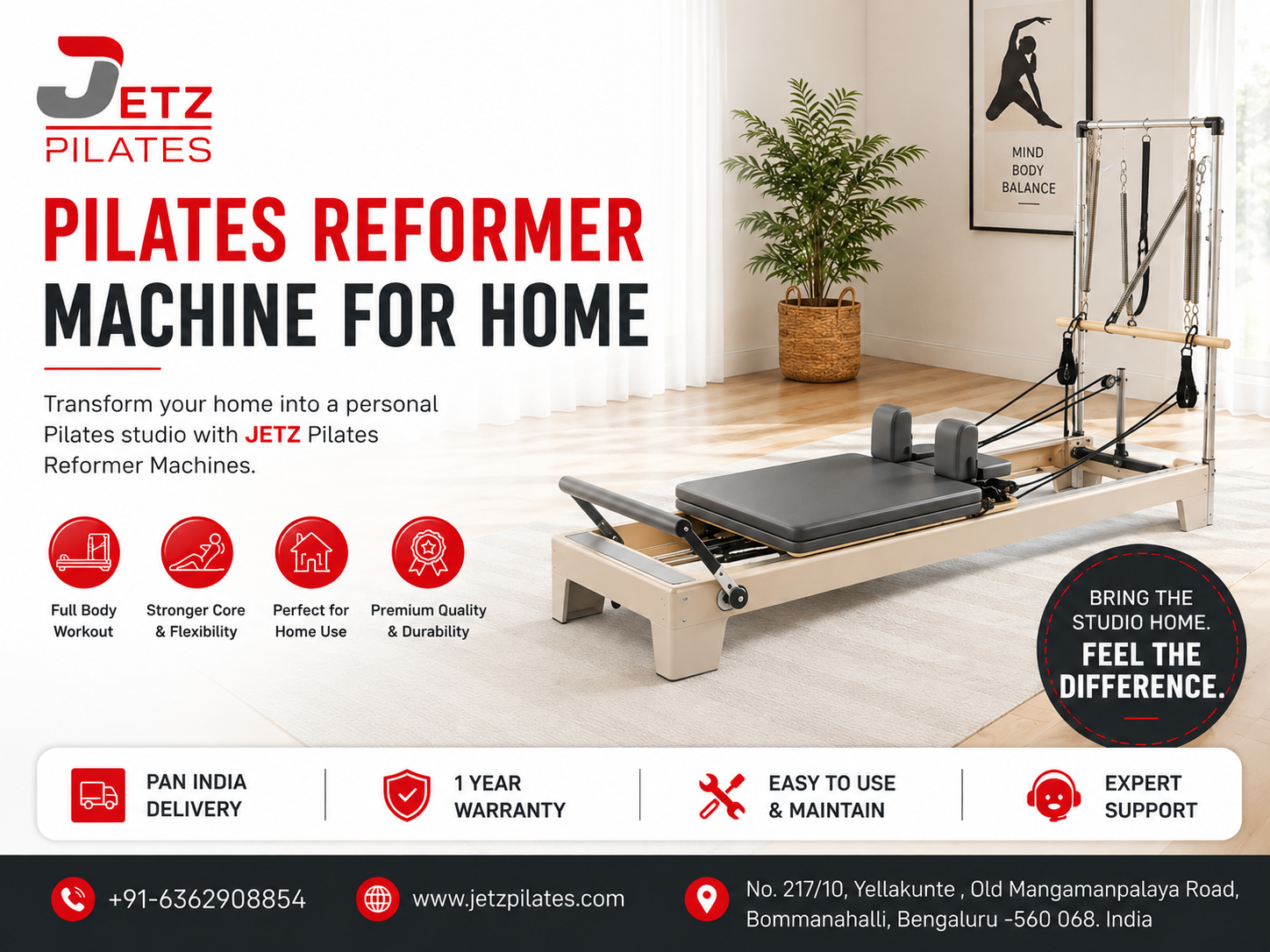
A Pilates reformer is a sliding-carriage resistance machine developed by Joseph Pilates in the early twentieth century.
Main Components
The machine consists of several key parts:
- Carriage—a padded sliding platform you lie, sit, or stand on
- Springs — provide adjustable resistance (usually 4–5 springs of varying tensions)
- Footbar — a padded bar you push against with your feet or hands
- Shoulder rests support your shoulders during lying exercises.
- Straps and pulleys—allow arm and leg exercises in multiple positions
- Frame — typically made of aluminum, steel, or wood
How It Works
You move the carriage along the frame by pushing or pulling against spring resistance. The springs can be adjusted to increase or decrease difficulty. This makes the reformer incredibly versatile, suitable for gentle rehabilitation and advanced athletic conditioning.
Beginner-Friendly Explanation
Think of it as a horizontal gym machine that uses your own body weight plus spring tension. You are never locked into one movement pattern. The reformer adapts to your body and your fitness level.
Mat Pilates vs. Reformer Pilates
Mat Pilates uses only bodyweight and gravity for resistance. It requires no equipment and is excellent for learning foundational movement patterns.
Reformer Pilates adds variable spring resistance, allowing greater range of motion and more precise muscle engagement. The reformer supports the body in ways that mat work cannot, making it more accessible for beginners and more challenging for advanced practitioners.
Both methods are valuable. The reformer simply adds depth, variety, and progression that mat work alone cannot offer.
How to Choose the Best Pilates Reformer for Home in India
Choosing the right machine requires honest self-assessment. Here are the key factors to evaluate.
Available Space
Measure your room before browsing models. A standard Pilates reformer is approximately 240–260 cm long and 60–70 cm wide.
You will also need clearance around the machine at least 50–60 cm on each side and at the footbar end. Tight spaces compromise your movement range and create safety hazards.
If space is limited, a foldable Pilates reformer or a compact Pilates equipment model may be a better fit.
User Experience Level
Beginners benefit from machines with clear spring labeling, adjustable footbar positions, and stable frames. Advanced users often require higher maximum resistance, longer carriage travel, and more accessory compatibility.
If you are buying for a household with mixed experience levels, look for machines with broad adjustability ranges.
Frame Quality
Aluminum frames are lightweight and rust-resistant. Steel frames are heavier but offer excellent durability for high-frequency use. High-quality wooden frames often seen in premium and clinical models provide superior stability and a classic aesthetic.
Avoid machines with thin, hollow metal tubing or unclear weight capacities. Frame quality directly affects machine stability, longevity, and your safety.
Resistance System
Springs are the primary resistance mechanism in most reformers. Look for machines with clearly color-coded springs and a minimum of four spring options.
Some modern models incorporate a rope-and-pulley tension system alongside springs. Ensure the resistance range matches your fitness goals; too little resistance limits progress; too much makes the machine inaccessible for beginners.
Portability
If you need to move or store your reformer regularly, a foldable Pilates reformer is the practical choice. These fold vertically to reduce their footprint when not in use.
Fixed-frame machines are heavier and less portable, but generally more stable during use. Consider how frequently you will need to relocate the machine before deciding.
Budget Considerations
Home Pilates reformer prices in India range widely from entry-level machines to high-end professional models. A higher price typically reflects better materials, stronger frames, a wider resistance range, and longer warranties.
Avoid the temptation to buy the cheapest available option. A poorly built machine may require costly repairs or replacement within a year.
Set a realistic budget based on how frequently you plan to use the machine and what features matter most to your practice.
Maintenance Requirements
All reformers require periodic maintenance. Springs need checking for wear. Wheels and rollers need cleaning. Upholstered pads may need replacement over time.
Some machines are easier to service than others. Check whether spare parts are available in India before purchasing an imported model. Machines with simple, accessible spring attachments and replaceable components have a clear advantage for long-term ownership.
Best Home-Friendly Pilates Reformer Models
Understanding the main categories helps you narrow your choice effectively.
Foldable Pilates Reformers
A foldable Pilates reformer is designed with hinged frames that allow vertical folding after use. These are ideal for apartments, shared spaces, or rooms that serve multiple purposes.
Advantages: Compact storage, easier to move, more affordable than premium fixed models.
Limitations: Slightly less stable than fixed frames, fewer accessory options, and may have a lower maximum weight capacity.
Ideal users: Home practitioners with limited space, beginners, single-user households.
Compact Pilates Reformers
Compact Pilates equipment for studio or home use is slightly shorter than standard models. These are designed for smaller rooms without sacrificing core functionality.
Advantages: Fits into tighter spaces, often lighter, suitable for most standard Pilates exercises.
Limitations: Reduced carriage travel distance may limit some advanced exercises.
Ideal users: Home practitioners in smaller apartments, travelers, and those who prioritize ease of setup.
Premium Home Reformers
Premium home reformers are engineered to studio-grade specification but designed for home environments. They typically feature aluminum or solid wood frames, wide carriage platforms, and comprehensive spring systems.
Advantages: High durability, superior stability, full exercise range, longer lifespan.
Limitations: Higher cost, heavier, not foldable in most cases.
Ideal users: Serious practitioners, instructors training at home, those seeking a long-term investment.
Studio-Grade Reformers for Home Use
Some buyers prefer true studio-grade reformers for their home. These are the same machines used in professional Pilates studios built for constant daily use, maximum stability, and the widest possible exercise range.
Advantages: Unmatched durability, professional-level resistance options, and compatibility with the full range of Pilates accessories.
Limitations: Significant investment, larger footprint, heavier to install.
Ideal users: Pilates instructors, rehabilitation professionals, dedicated enthusiasts with dedicated room space.
Budget-Friendly Reformer Options
Entry-level reformers offer a way to begin Pilates at home without a large initial investment. They typically use lighter frames, basic spring systems, and simpler adjustability.
Advantages: Accessible price point, good for exploring the method before committing further.
Limitations: Lower maximum weight rating, fewer resistance options, shorter expected lifespan.
Ideal users: Absolute beginners, those testing home practice before upgrading, those with strict budget constraints.
Foldable vs Fixed Pilates Reformers
| Feature | Foldable Reformer | Fixed Reformer |
| Space Requirements | Smaller when stored | Requires permanent space |
| Stability | Good | Excellent |
| Storage | Folds vertically, minimal footprint | Stays assembled |
| Durability | Moderate to good | Good to excellent |
| Portability | Easy to move | Difficult to relocate |
| Maintenance | Slightly more hinge maintenance | Standard spring and wheel care |
| Ideal User | Space-limited home practitioners | Dedicated home studios, professionals |
Home Pilates Reformer Price Guide
Understanding pricing helps set realistic expectations before you begin shopping.
Entry-level (₹40,000–₹80,000): Basic foldable or compact models. Suitable for beginners exploring the method. Limited resistance options and shorter lifespan.
Mid-range (₹80,000–₹200,000): Better build quality, wider resistance range, more stable frames. Suitable for regular home practice and intermediate-level users.
Premium (₹200,000–₹450,000): High-quality aluminium or wood frames, professional spring systems, full accessory compatibility. Suitable for serious practitioners and instructors.
Studio-grade (₹450,000 and above): Professional machines built for intensive daily use. Suitable for home studios, clinical settings, and instructor training.
The home Pilates reformer price is influenced by several factors:
- Frame material (aluminium vs steel vs wood)
- Number and quality of springs
- Carriage size and cushioning
- Accessory compatibility
- Country of manufacture
- Warranty and after-sales support
Consider the long-term investment calculation. A well-made reformer used daily for five to ten years costs significantly less per session than ongoing studio memberships. A cheap machine that fails within two years carries hidden costs.
Step-by-Step Home Pilates Setup Guide
Creating the right environment for your reformer makes every workout more effective and enjoyable.
Room Size Requirements
A minimum room size of 3m × 4m is recommended for comfortable reformer use. This allows adequate clearance around all sides of the machine. Larger rooms allow additional floor space for mat work and accessories.
For foldable Pilates reformer models, the same room dimensions apply during use; storage space is only relevant when the machine is folded.
Flooring Recommendations
Avoid setting up on thick carpet; it reduces machine stability and makes carriage movement uneven. Hardwood, laminate, or rubber flooring is ideal.
If you are placing the reformer on hard flooring, add non-slip rubber feet or a purpose-made reformer mat. This protects both the floor and the machine base.
Ceiling Height Considerations
Standard ceiling height (2.4m+) is adequate for most Pilates reformer exercises. However, some exercises performed with the jumpboard or standing on the carriage require additional overhead clearance.
Check your ceiling height before purchasing if you plan advanced standing work or if you are above-average height.
Lighting Setup
Natural light is ideal for a home Pilates space. It improves mood, allows accurate form observation, and makes the space more inviting.
If natural light is limited, opt for warm LED panels rather than harsh overhead fluorescents. Avoid placing the reformer where direct sunlight hits the springs or padding for extended periods UV exposure can degrade materials over time.
Ventilation
Pilates is a breathing-focused practice. Good air circulation improves performance and comfort. Ensure your room has at least one window or a ceiling fan.
Air-conditioned rooms work well just to ensure the unit is not blowing directly onto the machine, as cold air can stiffen springs slightly.
Storage Solutions
Even in a dedicated Pilates room, storage matters. Keep a small shelf or basket nearby for straps, yoga blocks, resistance bands, sticky socks, and a water bottle.
For foldable models, designate a specific wall space for the stored machine. Ensure the folded reformer is secured properly and will not tip.
Safety Considerations
Inspect the floor area for trip hazards before each session. Ensure all spring attachments are secure before use. Never adjust springs while the machine is under load. Keep children and pets away from the reformer during use.
Place the machine away from walls and furniture. You need clear space in every direction.
Space Measurement Guide Before Buying
Taking accurate measurements before purchasing prevents the most common buying mistake discovering the machine does not fit after delivery.
Recommended room dimensions:
- Minimum: 3m × 4m
- Comfortable: 3.5m × 5m
- Ideal (with mat space): 4m × 6m
Clearance requirements:
- Footbar end: minimum 60 cm
- Head end: minimum 60 cm
- Each side: minimum 50 cm (60–75 cm preferred)
Walk-around space: You should be able to walk completely around the machine without stepping over it.
Foldable machine requirements: When folded, most models occupy approximately 90 cm × 60 cm floor space. Confirm exact folded dimensions with your supplier before purchasing.
Pilates Reformer Assembly Guide
Most home reformers arrive partially assembled and require final setup before first use.
Delivery preparation: Clear your setup space before delivery day. Having a friend or family member available to help carry the box reformers is heavy. Most cartons weigh between 40 and 90 kg depending on the model.
Installation process: Follow the manufacturer’s instruction manual precisely. Do not skip or reorder steps. Attach the frame sections, insert shoulder rests, attach the footbar, connect the springs to the carriage, and thread the straps through the pulleys.
Common setup mistakes:
- Over-tightening bolts (can strip threads)
- Attaching springs in the wrong order
- Failing to level the machine on uneven floors
- Skipping the final stability check
Safety checks before first use:
- All bolts are finger-tight plus a quarter turn with a wrench.
- Springs securely hooked at both ends
- Carriage rolls smoothly without catching
- Straps are of even length and properly looped.
Professional assembly considerations: If you are uncomfortable with mechanical assembly, ask your supplier about professional installation services. This is especially relevant for studio-grade machines with more complex components.
Creating an Effective Home Pilates Workout Routine
Consistency transforms a reformer machine from furniture into a genuine fitness tool.
Beginner Program
Start with two to three sessions per week, 30–40 minutes each.
Focus on foundational movements: footwork series, hundred preparation, short spine, single leg circles, and rowing basics. Learn to control the carriage before adding spring resistance.
In the first four to six weeks, prioritise form over complexity. A single well-executed exercise is more valuable than ten poorly performed ones.
Intermediate Program
Move to three to four sessions per week, 40–55 minutes each.
Introduce standing work, long-box series, short-box series, and elephant variations. Begin working with lighter spring resistance to challenge stability. Pair reformer sessions with mat work for balanced practice.
Advanced Program
Four to five sessions per week, 50–60 minutes each.
Advanced practitioners can incorporate standing full series, arabesque variations, side splits, long-stretch series, and controlled push-up progressions. At this stage, working with a qualified Pilates instructor even periodically ensures continued safe progression.
Weekly Scheduling Tips
Avoid scheduling reformer sessions on consecutive days when starting out. Your body needs recovery time to adapt. Rest days can include light walking, stretching, or yoga.
As your conditioning improves, consecutive days become manageable but always listen to your body.
Recovery and Mobility Work
Foam rolling, gentle stretching, and breathing exercises on rest days support your reformer practice. Tight hip flexors, restricted thoracic mobility, and shoulder tension are common in desk workers — targeted mobility work between sessions accelerates your results.
Before and After Home Pilates Room Transformations
Designing your home Pilates space is a practical and creative process.
Small apartment setups: Many practitioners successfully use reformers in 10–12 square metre rooms. The key is strategic furniture arrangement. Fold-away or wall-mounted storage removes clutter. A foldable reformer maximises the remaining floor space for mat work.
Dedicated fitness rooms: A spare bedroom converted to a home studio is the most flexible setup. Add mirrors along one wall for form monitoring. Rubber flooring protects both the machine and the original floor surface.
Multi-purpose spaces: Living rooms, home offices, and guest bedrooms can double as Pilates spaces. A foldable reformer is stored against the wall or in a cupboard between sessions. Lightweight furniture that can be shifted easily makes this arrangement practical.
Maintenance Tips for Home Pilates Equipment
Well-maintained home Pilates equipment lasts significantly longer and performs more safely.
Cleaning procedures: Wipe down the carriage, footbar, and frame after each session with a damp cloth and mild cleaning solution. Avoid harsh chemicals that can degrade foam padding or corrode metal components.
Frame inspection: Monthly, check all bolts and connections for loosening. Tighten anything that has shifted. Check for visible cracks, rust, or damage on all frame sections.
Wheel maintenance: Carriage wheels and rollers collect dust and hair over time. Clean them monthly using a soft brush. Lubricate metal wheel axles lightly with a silicone-based lubricant once every three to six months.
Spring maintenance: Inspect springs for signs of stretching, rust, or deformation every one to two months. Springs that have lost consistent tension should be replaced. Never use a spring that appears damaged.
Storage recommendations: If you are storing the reformer for an extended period, release all springs to their lowest tension setting. Cover the machine with a breathable dust cover.
Long-term care: Replace upholstered pads when they show signs of tearing or compression. Keep a record of your machine’s service history. Follow the manufacturer’s recommended service schedule.
Common Mistakes When Buying a Home Pilates Reformer
Awareness of these pitfalls saves time, money, and frustration.
Buying solely on price: The cheapest option is rarely the best value. An underpowered or poorly built machine limits your practice and may fail prematurely. Compare cost against durability, functionality, and warranty terms.
Ignoring room measurements: Buying without measuring your space is the single most common mistake. Always measure twice, including ceiling height if you plan advanced work.
Choosing incorrect resistance levels: Beginners sometimes purchase machines with insufficient resistance range, limiting their progression. Advanced users occasionally buy machines that cannot provide enough resistance for their level. Match the machine’s range to your current and projected needs.
Overlooking maintenance needs: Every machine requires ongoing care. Check spare parts availability in India before purchasing. A machine that cannot be serviced locally becomes a liability.
Purchasing without future planning: Think about where your practice will be in two to three years. A beginner-grade machine may not serve you in eighteen months. Buying slightly above your current level often proves more economical in the long run.
Frequently Asked Questions
1. What is the best Pilates reformer for home use in India?
The best machine depends on your space, budget, and experience level. Premium aluminium-frame models offer the best balance of durability and home-friendliness. Foldable options suit smaller spaces. Consult a Pilates professional before purchasing if possible.
2. What is the typical home Pilates reformer price in India?
Prices range from approximately ₹40,000 for entry-level models to over ₹450,000 for studio-grade machines. Mid-range options (₹80,000–₹200,000) offer a practical balance of quality and value for most home users.
3. How much space does a Pilates reformer need?
A standard reformer needs a room of at least 3 m × 4 m with 50–60 cm clearance on all sides. Compact and foldable models can work in slightly smaller spaces.
4. Is a foldable Pilates reformer as good as a fixed one?
Foldable models are excellent for home use with limited space. They perform well for most Pilates exercises. Fixed frames offer marginally greater stability, which matters more for advanced work and higher-frequency use.
5. How often should I service my reformer?
Monthly visual inspections and cleaning are recommended. Full servicing — checking springs, wheels, bolts, and straps — should happen every three to six months depending on usage frequency.
6. Is a Pilates reformer suitable for complete beginners?
Yes. The reformer is one of the most beginner-accessible pieces of fitness equipment available. The spring resistance system supports the body during learning. Starting with beginner sessions guided by a qualified instructor is strongly recommended.
7. Can a studio-grade reformer be used at home?
Absolutely. Studio-grade machines offer superior durability and performance. If space and budget allow, they are an excellent long-term investment for dedicated home practitioners and instructors.
8. How many times per week should I use a home Pilates reformer?
Beginners should start with two to three sessions per week, 30–40 minutes each. Intermediate and advanced practitioners typically train three to five times per week. Rest and recovery days remain important at every level.
9. How long does a quality Pilates reformer last?
A well-maintained, high-quality reformer should last ten to fifteen years or more. Entry-level machines may require replacement or significant repairs within three to five years of regular use.
10. Are Pilates reformers safe to use without an instructor?
With proper self-education and careful progression, many exercises can be performed safely at home. However, at least a few in-person or online sessions with a qualified Pilates instructor is strongly recommended before beginning independent practice.
Expert Buying Considerations
Selecting the right machine comes down to an honest, practical self-assessment across five dimensions.
Lifestyle: How often will you realistically use the machine? Daily users should invest in mid-range or premium models. Occasional users can consider entry-level options, provided they do not limit future progression.
Space availability: Your available space determines whether a foldable, compact, or full-size model is practical. Never compromise on clearance; a tight setup creates safety risks and frustrates your practice.
Fitness goals: Rehabilitation and gentle mobility work require different machine specifications than athletic conditioning or instructor training. Align your machine’s resistance range and build quality with your actual goals, not aspirational ones.
Budget: Establish a realistic budget before you begin browsing. Include delivery and potential professional assembly costs. Factor in long-term value rather than purchase price alone.
Long-term usage expectations: If you are new to Pilates, consider where your practice might be in two years. Buying slightly above your current needs often prevents an expensive upgrade later.
Conclusion
The best Pilates reformer for home in India is not a single machine; it is the right machine for your specific space, goals, budget, and lifestyle.
Home Pilates is no longer a luxury accessible only to studio members. With careful planning and informed purchasing, a quality reformer brings professional-standard training directly into your home.
Prioritise space assessment before anything else. A machine that does not fit your room cannot serve you, regardless of its quality.
Match the resistance range and build quality to your actual fitness goals, not your most optimistic projections. Consider maintenance requirements and spare parts availability in India before finalising your choice.
A thoughtfully selected reformer properly set up, well-maintained, and consistently used is one of the most effective long-term investments you can make in your physical health.
Take your time, do your research, and choose with confidence.